Loading...
Product Manager2024MVP Strategy
Unburden
Mental Health for Young Professionals
51% of young professionals need mental health help — but 74% have never used a wellness app.
Role
Product Manager
Market Size
33M SOM
Focus
Non-Clinical Wellness
33M
Target Users (SOM)
11
Features Prioritized
30+
Survey Responses
6
User Interviews
The Problem
A Growing Mental Health Gap
Young professionals face unique mental health challenges — not severe enough for clinical intervention, but serious enough to affect daily life.
Core Mental Health Challenges
51%
Need Help
Young professionals reporting challenges
43%
Anxiety
Screened positive for anxiety
31%
Depression
Screened positive for depression
53%
Burnout
Experience burnout weekly
Workplace & Social Impact
79%
Gen Z Lonely
Ages 18-22 feeling lonely
45%
Isolated at Work
Feel isolated in workplace
48%
Work Stress
High workplace stress
72%
Prefer Apps
Prefer mobile sessions
Gen Z Receptivity to Mental Health Services
90%
Open to Services
65%
More Receptive
72%
Prefer Mobile
"Not severe enough for therapy, but serious enough to affect daily life"
This "middle ground" is underserved by both clinical and consumer wellness solutions.
Market Opportunity
A $153B Market by 2034
The mental wellness market is experiencing explosive growth, driven by increased awareness and changing attitudes toward mental health.
Global digital mental health market
Market Size (USD Billion)
27.84
153.03
20242034
Broader mental health technology market
Market Size (USD Billion)
7.13
32.97
20232032
90%
express openness to mental health services
65%
Gen Z show greater receptivity
72%
Gen Z (18-24) prefer mobile app-based sessions
Impact Calculation
1.7B
Total Available Market (TAM)
870M
Total Addressable Market (TAM - Refined)
610M
Serviceable Addressable Market (SAM)
33M
Serviceable Obtainable Market (SOM)
TAM: 1.7B
The global workforce of Millennials and Gen Z in early to mid-career stages
Global labor force: ~3.5 billion × 75% Millennials & Gen Z × 65% Early/Mid-Career
TAM-R: 870M
Subset actively experiencing mental health challenges addressable by non-clinical solutions
51% of young professionals report needing help for emotional/mental health
SAM: 610M
Young professionals open to utilizing non-clinical digital mental health solutions
70% are open to non-clinical digital solutions
SOM: 33M
Realistic segment acquirable within initial 3-5 year operational period
Conservative ~5.4% market capture rate
Competitive Analysis
Understanding the Landscape
Analysis of 5 key players in the mental wellness space revealed gaps in personalization and professional support integration.
| Competitor | Focus | Strengths | Weaknesses | Personalization | AI-Powered |
|---|---|---|---|---|---|
| Calm | Meditation & Sleep |
|
| Low | |
| Wysa | AI Chatbot Therapy |
|
| Medium | |
| Rocky.ai | AI Coaching |
|
| Medium | |
| Finch | Gamified Self-Care |
|
| Low | |
| Headspace | Meditation & Mindfulness |
|
| Low |
Calm
Meditation & Sleep
Low
Strengths
- • High brand awareness
- • Celebrity content
- • Sleep stories
Weaknesses
- • Generic content
- • Expensive
- • Not personalized
Wysa
AI Chatbot Therapy
MediumAI
Strengths
- • CBT-based
- • Conversational
- • Evidence-backed
Weaknesses
- • Limited tracking
- • Text-only
- • No wearable integration
Rocky.ai
AI Coaching
MediumAI
Strengths
- • Goal-oriented
- • Daily check-ins
- • Motivational
Weaknesses
- • Limited mental health focus
- • No community
- • Basic analytics
Finch
Gamified Self-Care
Low
Strengths
- • Engaging UX
- • Habit building
- • Low pressure
Weaknesses
- • Shallow insights
- • No professional support
- • Young audience
Headspace
Meditation & Mindfulness
Low
Strengths
- • Quality content
- • Work partnerships
- • Animations
Weaknesses
- • Content library fatigue
- • Not adaptive
- • Expensive
Market Gap Identified
No existing solution combines high personalization, AI-powered insights, and wearable integration specifically for young professionals in the non-clinical space.
Hypothesis
Six Barriers to Adoption
Before conducting user research, we identified six key barriers preventing young professionals from using mental wellness apps.
1. Awareness
Target users are unaware of non-clinical digital solutions available to them
2. Distrust in Reliability
Skepticism about whether digital tools can provide meaningful support
3. Value Comparison
Preference for informal coping (friends, family) over structured app-based approaches
4. Ingrained Habit
Existing coping mechanisms (healthy or unhealthy) are hard to replace
5. Poor User Experience
Apps are perceived as generic, high-effort, and lacking visible progress
6. Privacy Concerns
Fear of data exposure and judgment prevents users from engaging openly
User Research
Validating Our Hypotheses
Quantitative surveys and qualitative interviews revealed what young professionals actually need — and confirmed our key hypotheses.
01
Survey
30+ responses on wellness habits & pain points
02
Interviews
6 in-depth conversations (45-60 min each)
03
Synthesis
Affinity mapping & persona development
04
Validation
Hypothesis testing & feature prioritization
Key Research Findings
97%
Want Tracking
Interest in monitoring emotions
75%
Tried Wellness
Experimented with practices
49%
Want Wearables
Interest in health data sync
Hypotheses Validated
Distrust in Reliability
80%Don't believe apps can truly help
Communication Struggle
83%Difficulty articulating feelings
Low App Adoption
66%Never tried a wellness app
Why Users Stop Using Apps
Too Generic
70%Content not personalized
Too Much Effort
60%Too much time and cognitive load
Guilt & Shame
50%Felt guilty when missing sessions
User Personas
Who We're Building For
Two primary personas emerged from research, representing distinct needs within our target market.
SC
Sarah Chen
29, Data Scientist
The Analytical Seeker"I don't just want to feel better; I want to understand why I feel what I feel. Give me data, insights, and proven strategies, not just platitudes."
Needs
- • Understand root causes and emotional patterns
- • Measurable progress and data-driven insights
- • Evidence-based techniques and research-backed strategies
- • Systematic improvement for resilience
Pain Points
- • Frustrated by generic advice lacking principles/results
- • Apps feel "fluffy" or unscientific, lacking depth
- • Difficulty tracking well-being without clear metrics
- • Feels like guessing, lacks structured plan
PJ
Pratik Joshi
26, Equity Analyst
The Overwhelmed Achiever"The constant pressure of my career is draining me. I need a reset button that doesn't add to my endless to-do list."
Needs
- • Quick, effective stress and anxiety management
- • Visible progress and feeling calmer/more focused
- • Absolute privacy and confidentiality
- • Personalized, tailored advice for unique pressures
Pain Points
- • I'm constantly in burnout and exhaustion
- • Emotional state harms work productivity
- • Mental wellness apps feel like a chore
- • Generic advice from friends/online
Problem Framing
Structured Problem Analysis
Using a Problem Framing Canvas to systematically define the problem space, validate assumptions, and articulate value.
Framing the Problem
A structured canvas to define the problem space, validate assumptions, and articulate value.
What is the true problem?
Ineffective & Unengaging Current Solutions
Existing non-clinical digital mental well-being tools are often generic, demand high effort, and fail to demonstrate tangible improvement, leading to user distrust.
Frequent, Impactful Emotional Distress
Young professionals face high emotional distress that significantly impacts their work, relationships, and overall enjoyment of life.
Privacy Concerns Deter Engagement
Despite the potential for digital anonymity, strong user concerns about data privacy and the perceived visibility of their struggles deter engagement.
Barrier to Articulation & Relevant Help
A significant struggle to clearly explain feelings hinders effective coping and the ability to receive truly personalized and relevant support.
Who are the customers facing this problem?
Young Professionals with Mental Health Challenges who are open to utilizing non-clinical digital mental health solutions that a new non-clinical mental well-being solution can realistically acquire within its initial operational period (e.g., 3-5 years).
33MSOM Target
How do we know it is a real problem?
User Research
Survey shows high distrust (80%), Communication Struggle (83%), Low App Adoption (66%) and Poor App Experience.
Hypothesis Validation
Confirmed Poor User Experience, Distrust in Reliability, Value Comparison (informal vs. structured coping), and Concerns about Privacy as significant barriers.
What is the value generated by solving this problem?
For the target customers
- • Improved emotional well-being and reduced distress
- • Enhanced work productivity and personal relationships
- • Access to personalized, effective, and low-effort coping mechanisms
- • Increased self-awareness and ability to articulate emotions
- • Empowerment through consistent, visible progress tracking
For the business
- • Significant untapped market opportunity (65.52% haven't used apps)
- • High potential for user acquisition and long-term retention
- • Establishment as a leader in personalized, effective non-clinical digital mental wellness
- • Positive social impact by improving the well-being of a critical demographic
Why should we solve this problem now?
Urgent & Widespread Need
A large majority of young professionals are actively struggling with frequent emotional distress, impacting multiple life areas.
Ineffective Current Solutions
Existing digital and informal coping mechanisms are failing to provide adequate or sustainable support, as evidenced by low adoption and high abandonment rates.
Clear Market Opportunity
There is a strong, unmet demand for personalized, easy-to-use, effective, and private digital solutions that can demonstrate tangible progress.
Gap in Personalized Support
Addressing these barriers now offers a unique opportunity to create meaningful impact and capture significant market share in the growing digital mental health space.
Solution
Introducing Unburden
A non-clinical digital wellness platform that helps young professionals recognize, regulate, and reflect on their mental health.
Recognize
Self-discovery assessment creates personalized baseline
Regulate
Daily AI-curated practices adapt to your needs
Reflect
Guided journaling reveals patterns and progress
Must Have
Self-Discovery Assessment
Personalized baseline evaluation
Daily Resilience Practice
AI-curated 5-min exercises
Wearable Data Sync
Apple Health/Fitbit integration
Guided Reflection Journal
Prompted journaling with insights
Should Have
Community Forums
Anonymous peer support
Professional Directory
Vetted therapist connections
Crisis Resources
Hotline integration & detection
Could Have
Workplace Wellness Portal
B2B dashboard for HR teams
Gamification Layer
Streaks, badges, challenges
Won't Have (Now)
Clinical Diagnosis
Not a medical tool
Live Therapy Sessions
Out of scope for MVP
User Experience
User Flows & Wireframes
Mapping the key user journeys from onboarding to daily engagement.
Task Flow

User Flow

Key Screens (Wireframes)
Low-fidelity wireframes showing the core user journey. Visual exports from Figma to be added.
Welcome to Unburden
Welcome
Onboarding introduction
Question 3 of 10
Assessment
Self-discovery questions
Your Daily Practice
Daily Practice
Personalized exercises
Your Bio-Rhythm
Wearable Data
Bio-rhythm insights
My Journey
Growth Story
Progress visualization
10:30 AM Check-in
Notification
Smart reminders
User Scenario: Pratik's Morning
It's 7:30 AM. Pratik wakes up to a gentle notification from Unburden. His wearable data shows he only got 5.5 hours of sleep — the app noticed his sleep has been declining this week.
Instead of the usual 5-minute mindfulness exercise, Unburden suggests a shorter 2-minute breathing exercise designed for low-energy mornings. Pratik completes it while his coffee brews.
The app logs this as day 12 of his streak and shows a quick insight: "Your stress levels tend to spike on Wednesdays. Today's practice focuses on pre-emptive calm."
Technical Architecture
System Design
High-level architecture showing the AI-powered personalization engine and data flow.
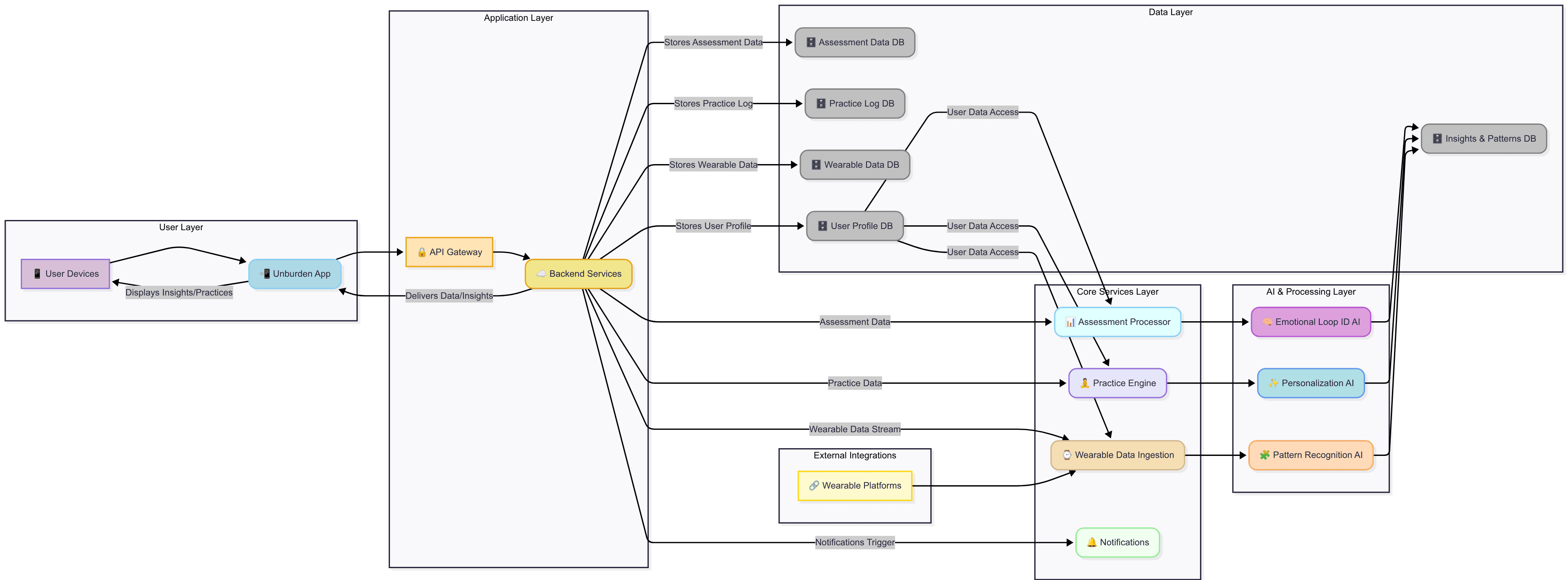
User Layer
- • Mobile app (iOS/Android)
- • Wearable integrations
- • Push notifications
AI/Processing Layer
- • Personalization engine
- • Pattern recognition
- • Content curation
Data Layer
- • Encrypted user data
- • Wellness content library
- • Analytics & insights
Business Strategy
Monetization & Distribution
A sustainable business model combining B2C freemium and B2B2C partnerships.
Revenue Streams
Freemium B2C
Free tier with core features, premium subscription for advanced insights
$9.99/month$79.99/year
B2B2C Partnerships
Corporate wellness programs with employer-sponsored access
$5/employee/month
Distribution Strategy
Peer-Led Growth
Referral incentives and social sharing of milestones
Corporate Wellness
B2B sales to HR teams seeking employee wellness solutions
Content Marketing
SEO-optimized wellness content and social media presence
Measuring Success
Key Performance Indicators
A comprehensive metrics framework to track product health and user outcomes.
Primary Success Metrics (North Star)
10,000
Weekly Active Users (WAU)
Core engagement indicator
40%+
7-Day Retention
Industry benchmark for wellness apps
75%
Assessment Completion
Users finishing onboarding flow
Engagement Metrics
Daily Practice Streak
5+ days avg
Session Duration
5-8 min
Feature Adoption
3+ features/user
Business Metrics
Free-to-Premium Conversion
5-8%
NPS Score
50+
Launch Criteria
Go/No-Go Decision Framework
Clear criteria for evaluating MVP success and making data-driven launch decisions.
Go Criteria
If we hit these metrics, we're ready for broader launch
- 7-day retention ≥ 35%
- NPS score ≥ 40
- Daily practice completion ≥ 60%
- Self-reported improvement ≥ 50% at 30 days
No-Go Criteria
Red flags that require pivoting or major iteration
- 7-day retention < 20%
- NPS score < 20
- App crashes > 2% of sessions
- Negative mental health signals increasing
Success Milestones
30 Days
1,000 users onboarded, 60% assessment completion
60 Days
5,000 users, 35% 7-day retention, first premium conversions
90 Days
10,000 users, 40% retention, 5% premium conversion
Thanks for reading!
This case study demonstrates my approach to product strategy, market analysis, and user-centered feature prioritization.